
Xi Jintao
A question, a difference, and an anecdote.

I thought this recently re-upped October 2024 thread on X by the excellent Jonathon P Sine was spot on. In it he tied together disparate threads on how Xi Jinping (习近平) has carried on much of what his predecessor Hu Jintao (胡锦涛) started and/or nurtured. Everything from suffocating civil society to enforcing environmental protections, from Party building to big state sponsorship of the tech sector – it was all the Party’s platform under Hu from the mid-2000s, just as its been under Xi since.
The Party leadership turned more conservative in the mid-2000s, losing its (already fragile) faith in the market and liberal freedoms. It was just that General Secretary Xi figured out a way to ram those policies home via an imperial executive and a strengthened Party apparatus.
I wanted to present three quick thoughts: a question, to point out an important difference between the two, and third, recall what I think is a telling anecdote.
First, and this is one for the archives if they ever open up: How much of the mid-2000s’ agenda was Hu’s, and how much was freelancing by his Standing Committee colleagues? Was the crackdown on civ-soc really pushed by Hu, or was it empire building by Zhou Yongkang (周永康) et al. largely operating outside General Secretary Hu’s control? All the money thrown at the IT sector: how much was that Hu, and how much was it Jiang Zemin (江泽民) et al. making sure that Jiang Jnr. et al. were amply funded? I don’t know the answers but there is an apparent contradiction in the assertions that (1) Hu was powerless and (2) The policies that emerged under him were his.
Second, the Hu administration’s approach to social welfare is, I think, a clear difference, and Hu himself seemed personally committed to them. Under Hu and his premier Wen Jiabao (温家宝), we got rural medical insurance (新型农村合作医疗) in 2003, the extension of rural minimum income insurance (农村低保) nationally in 2007, and a pilot for rural pensions (新型农村社会养老保险) in 2009, which was eventually nationalised. All of that was backed with central government funding. And in 2006, we got the early cancellation of the agricultural tax.[1] All good news for rural China.
Now, we have got some welfare reforms under Xi, but they’ve been institutional and have mostly not involved extra funding. In 2016, the urban and rural medical insurance schemes were merged (城乡居民医疗保险), making it easier for migrants to access and in 2017 hospital markups on drugs were banned.[2] (And we recently got a retirement age reform, adding three years over a 15 year phase-in period – necessary, but hardly a gift to the less privileged).[3] After an step-up in spending on health and education as a share of national income during the Hu-Wen years, they’ve largely flat-lined since 2012.[4] Maybe Common Prosperity will make a comeback, but for the moment it seems the Xi administration has other budgetary priorities.
And third, here’s the anecdote. A friend with access told me a tale in late 2012, just after the 18th Party Congress, when Xi took over. Hu Jintao wanted the world to know that he was a fan of his successor, and that’s why he was resigning all his posts and handing over power cleanly (or nakedly, as we say). So much so that the twenty-four minute delay in the new Standing Committee walking out onto that stage was because Hu wanted to introduce them and sing Xi’s praises. Somehow Hu was talked down, I was told.
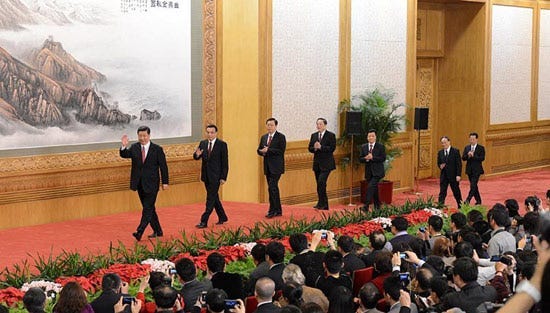
Xi et al. finally appeared at 11.54am[5]: “Sorry to have kept you waiting. I am very happy to meet with you, friends of the press (让大家久等了,很高兴同各位记者朋友见面)”. And what a great friendship that turned out to be.
This is one of the many reasons I’m sceptical that Xi deliberately humiliated Hu at the 20th Party Congress. Chinese politics isn’t Rome; here spectacle is all about order (even if it’s all a knife fight behind the stage) and respect of one’s elders (even if you’ve made them irrelevant), rather than having the crowd roar as the lion rips your opponent to shreds. Rather, I think allowing Hu to sit on that stage with his Parkinson’s was likely an act of respect.
I’m speculating, of course, but I guess that respect was earned while Xi sat at the Politburo Standing Committee table for five years, each week seeing Hu flail in his ability to push his agenda, much of which you agreed with. I can imagine him sitting there quietly, alternatively plotting how he could avoid Hu’s fate, and then sweating about what would happen if he couldn’t pull that off.
[1] China Net [中国网], 2006年起废止农业税:中国农业的第三次革命 [The Abolition of Agricultural Tax in 2006: The Third Revolution in Chinese Agriculture.], 21 September 2009, https://news.sina.cn/sa/2009-09-21/detail-ikftpnny4187199.d.html.
[2] Mihajlo Jakovljevic etal., ‘Successes and Challenges of China’s Health Care Reform: A Four-Decade Perspective Spanning 1985—2023’, Cost Efficiency Resource Allocation, 30 August 2023, https://pmc.ncbi.nlm.nih.gov/articles/PMC10469830/.
[3] ‘China’s Retirement Age Reforms Not Enough to Fix Pension Headache’, Reuters, 23 September 2024, https://archive.ph/hXmFw, https://www.reuters.com/world/china/chinas-retirement-age-reforms-not-enough-fix-pension-headache-2024-09-23/.
[4] I’m no expert here, so am open to feedback, but I’m just looking at tax-funded programs, rather than the employee/employer funded social insurance schemes where spending (and contributions) have been rising, mechanically.
[5] ‘新一届中央政治局常委记者见面会 七位常委集体亮相 [The New Standing Committee of the Political Bureau of the CPC Central Committee Held a Press Conference, with All Seven Members Making Their First Public Appearance.]’, People’s Daily Online [人民网], 15 October 2012, http://cpc.people.com.cn/18/n/2012/1115/c350840-19590392.html.
Interesting stuff, I had offend wondering what the motivation was behind the infamous “escorting Hu out” incident was all about. Great read!
As you hinted, some of these predate even Hu. In terms of the security state stuff has to take into account of what he did in Tibet, which made him much less reformist at least than Wen. I’d like to think Hu (and Wen), like Jiang, were still scarred by the takedown of Hu Yaobang & Zhao Ziyang and his inclination would be to consolidate and let someone else (which comes in the concrete form of Li Keqiang, and to a lesser extent Li Yuanchao and Wang Yang) do the hard work. And to that end there was hope with Xi, given the image of Xi Zhongxun and Xi’s own record in Fujian and Zhejiang. Shame it all came to naught in the end.