
Get off my lawn!
Far fewer young cadres are rising up into the ranks of the Central Committee.

The age of the Politburo is edging up under General Secretary Xi Jinping (习近平). Provincial Party Secretaries are getting older too. And the broader Central Committee – from which current and future leaders are picked – is losing its blessed youthfulness too.
Xi Jinping was fully in charge of selection of the 20th Central Committee in 2022[1] and he chose the fewest number of young cadres in the reform era. We normally get at least 20-30 under-55s becoming full members. But according to my numbers, just three[2] of the 205 full members were under 55 when they were selected at the end of the Congress.[3]
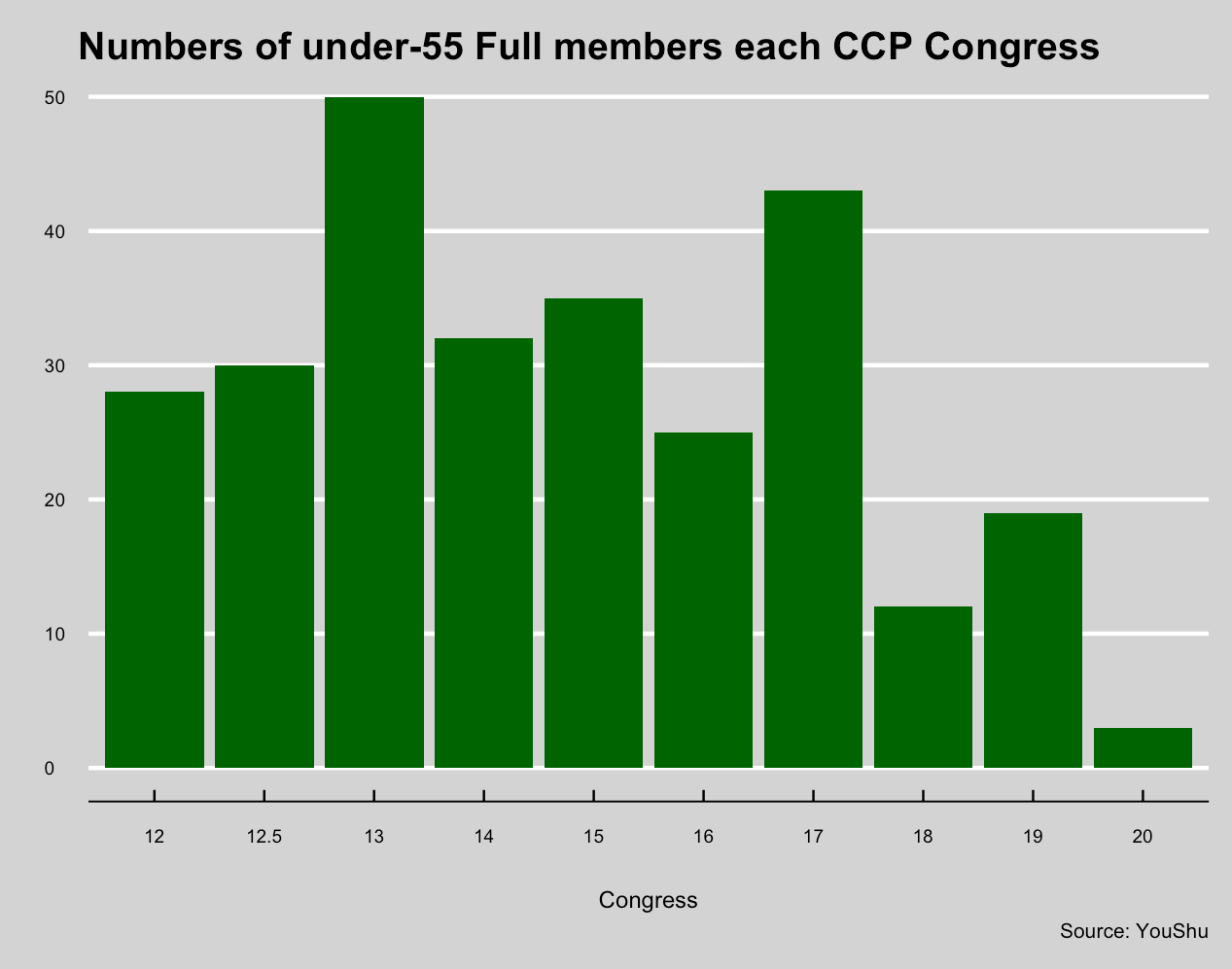
In the post-1976 era, we’ve enjoyed two large infusions of youth into the Central Committee:
At the 13th Congress, when Deng Xiaoping (邓小平) organized the wholesale retirement of many of his peers and refreshed the ranks with reform-minded boys;
And at the 17th Congress in 2007, when and Hu Jintao (胡锦涛) also attempted to boost the stock of future leaders.[4] That was the Congress when Xi himself joined the Politburo Standing Committee (PBSC).
Both Deng and Hu were trying to nurture and promote younger talent to ensure the Party flourished well beyond their terms. It seems Xi is not yet in that mode.
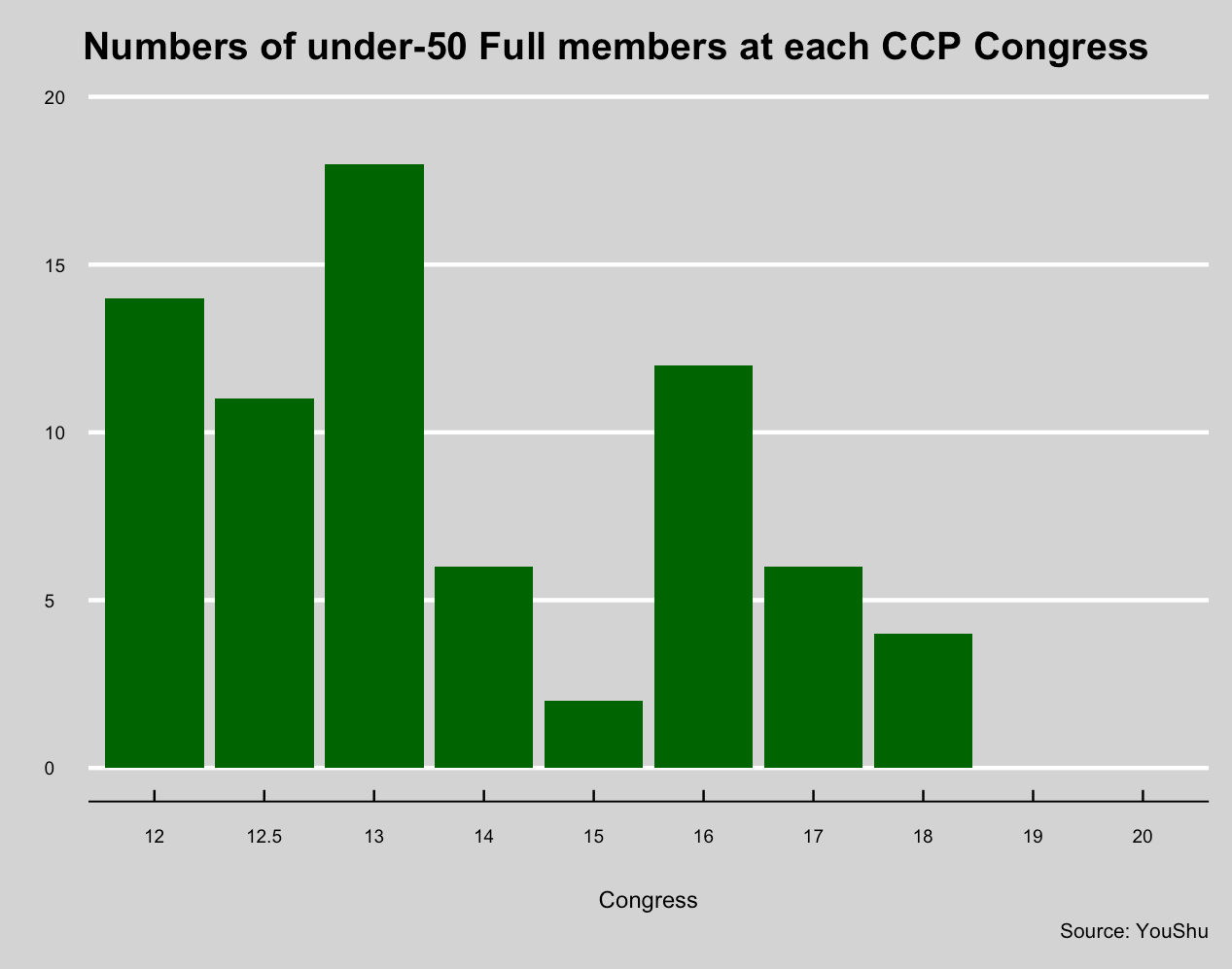
The situation for under-50s was ever grimmer. Xi chose ZERO of them to join him in the Central Committee at the 19th and 20th Congresses. Talk about a lack of succession planning.
Funnily enough, the average age of a Central Committee member is not rising as a result.
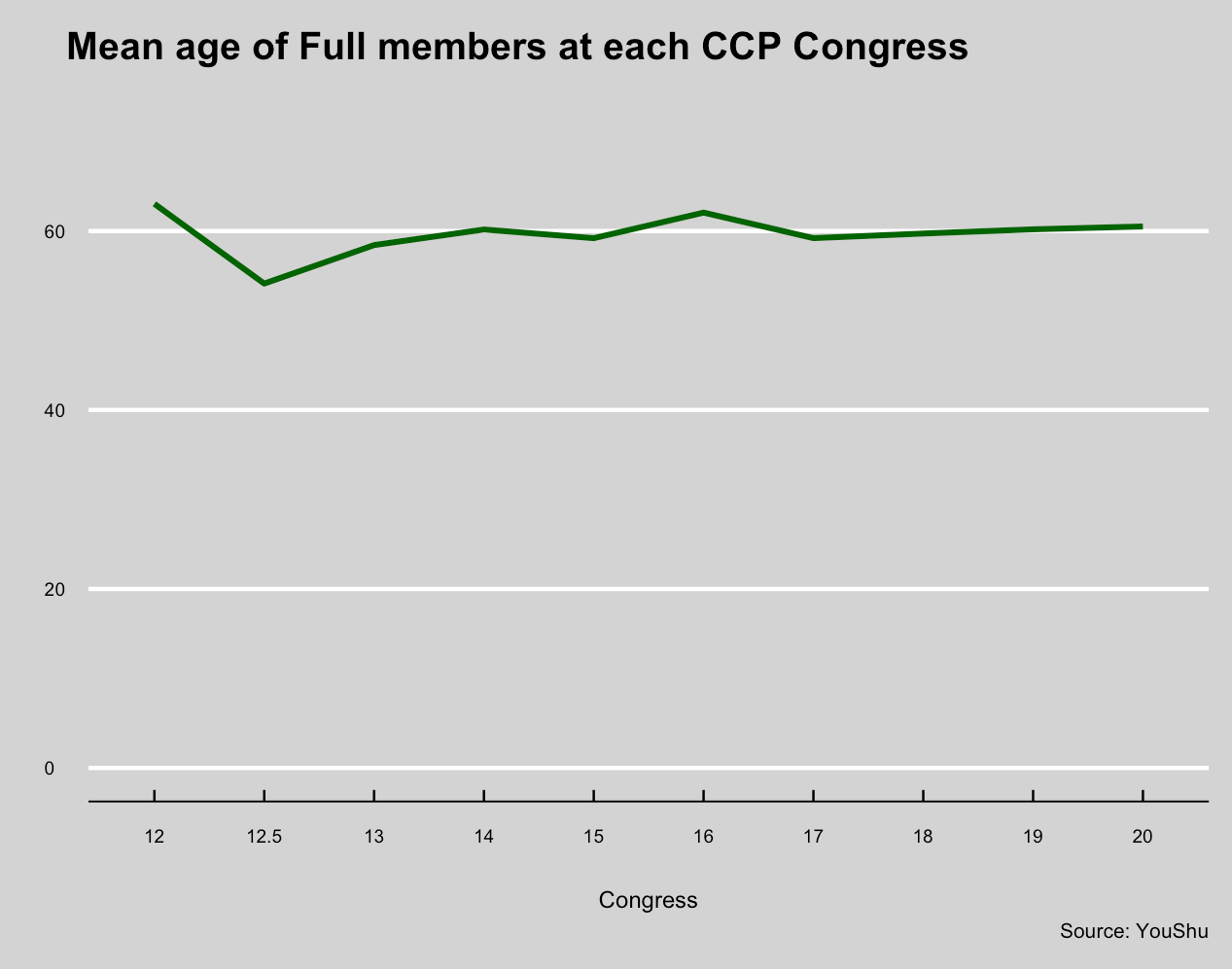
It’s rather that there are more members in their late 50s/early 60s.
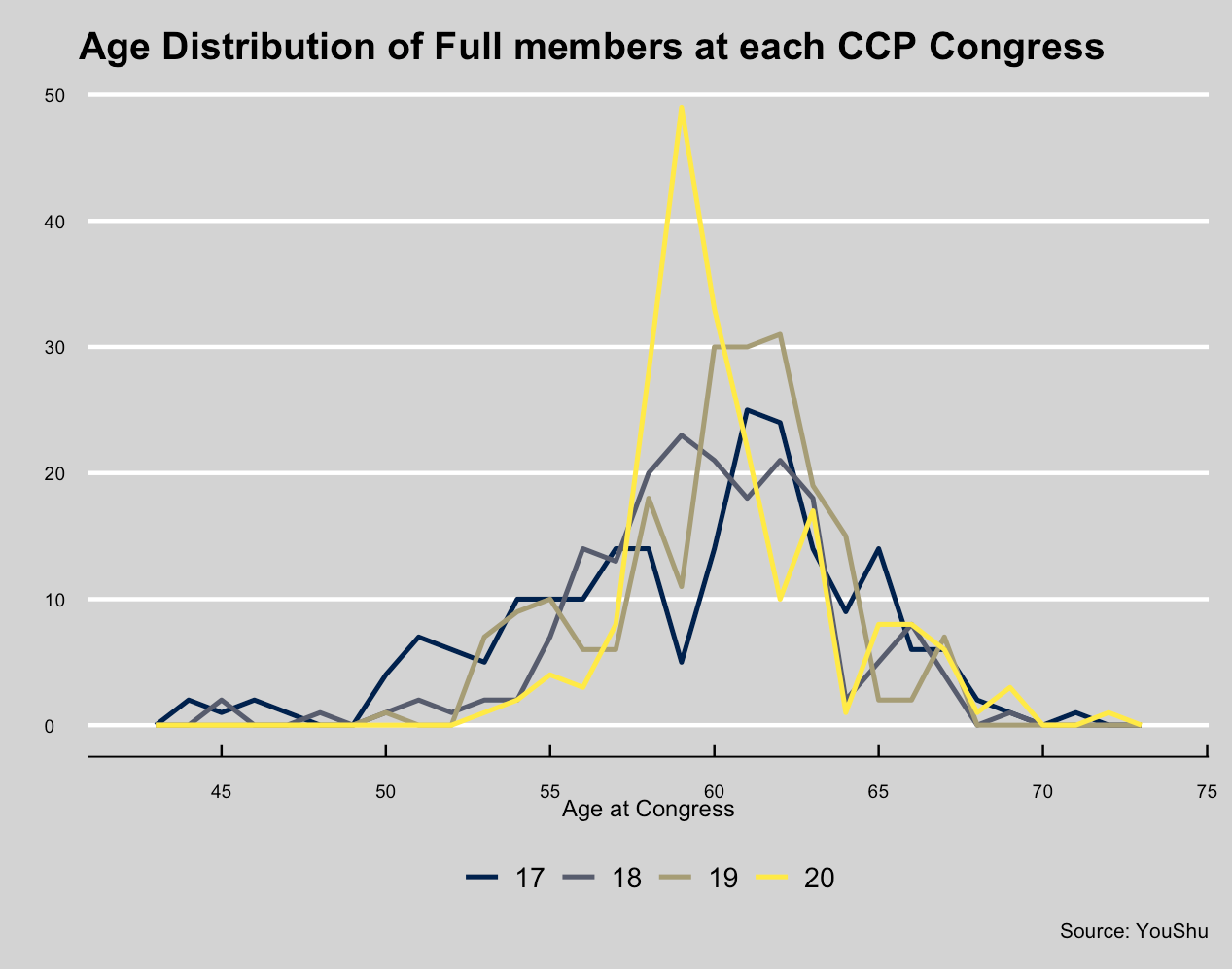
Fewer young-uns, but also a spike in the numbers aged 59 at the 20th. (At a stretch perhaps one could argue that’s evidence of more prep for the following five years, and less prep for beyond that?)
But wait, you might shout – what about the alternate members? Each Congress elects some 170 alternates, those who (supposedly) wait in the wings to take up leadership positions in the future.[5] Surely the 20th Congress’ batch of them are more youthful, right?
Err, no. The 19th and 20th Congresses also saw many fewer young alternates elected than usual too.
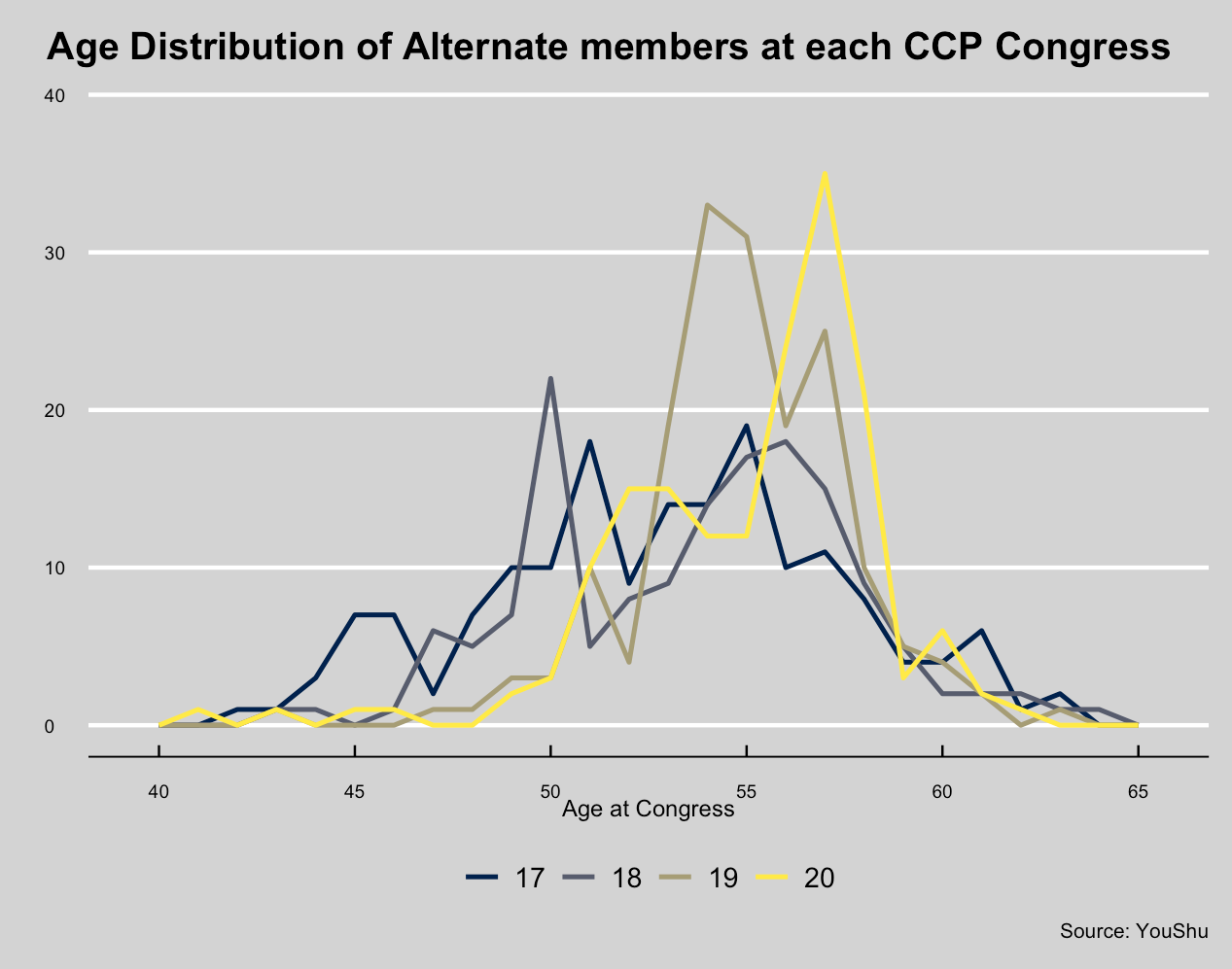
Which means that the odds are pushing us towards an even older Central Committee being formed at the 21stCongress in 2027.
That said, though, that is not destiny as Xi is also choosing to elevate fewer alternates. Back at the 18th Congress, 46% of alternates who had been ‘elected’ at the 17th were promoted to full membership; at the 19th 39% of the 18th’s batch and at the 20th only 31% of the 19th’s batch. And, the average age of those promoted is up too – 53.8 years old at the 18th, 55.3 at the 19th and 55.9 at the 20th.
Finally, it’s worth remembering that aging politicians are not unique to the Communist Party. The average age of a sitting US Senator in January 2025 was 64, while the mean age of the 20th Central Committee members today is 61. Perhaps given better healthcare et al. these days, 60 is the new 50?
[1] Cheng Xiaonong [程晓农], ‘中共二十大中央委员如何组成? [How Were the Members of the 20th CPC Central Committee Composed?]’, RFA, 28 October 2020, https://www.rfa.org/mandarin/pinglun/chengxiaonong/cxn-10282022121015.html.
[2] The lucky three in 2022: Zhong Shaojun (钟绍军), Xi’s former PLA secretary who may now be in trouble; He Junke (贺军科), a former space engineer who now runs the day-to-day work of the China Association for Science and Technology (中国科学技术协会), a ‘second front’ posting that suggests he isn’t positioned for future great things; and Yin Yong (殷勇), Beijing’s high-flying mayor who previously worked at the People’s Bank, and who impressed Cai Qi (蔡奇) in the deputy mayor job, and who does seem destined for greatness.
[3] A note on method. I’ve sourced dates of birth from online biographies. When a day/month was unavailable I’ve assumed the first day of the month/January. In a very small number of cases (notably with PLA members) I’ve been unable to find a date of birth, so I have omitted these delegates from the dataset. A handful of alternates get promoted to full Central Committee status during the five-year term, but I’ve just focused on their age at the Congress.
[4] Alice Miller, ‘China’s New Party Leadership’, China Leadership Monitor, January 2008, https://www.hoover.org/sites/default/files/research/docs/CLM23AM.pdf.
[5] And as full members fall to corruption etc. investigations, their numbers are made up from the (not-being-investigated) pool of alternates.